


One of the most common questions patients ask before a hair transplant is simple:
How dense will my hair look after the procedure?
The answer is more complicated than simply counting grafts.
Two patients can receive the same number of grafts and still achieve very different visual results. Hair thickness, donor quality, scalp colour, curl, the size of the recipient area and the way grafts are distributed all influence how dense the final result appears.
At Laser Way Clinic in Tirana, hair transplant planning focuses not only on how many grafts can be transplanted, but also on how those grafts can be used efficiently to create natural-looking coverage.
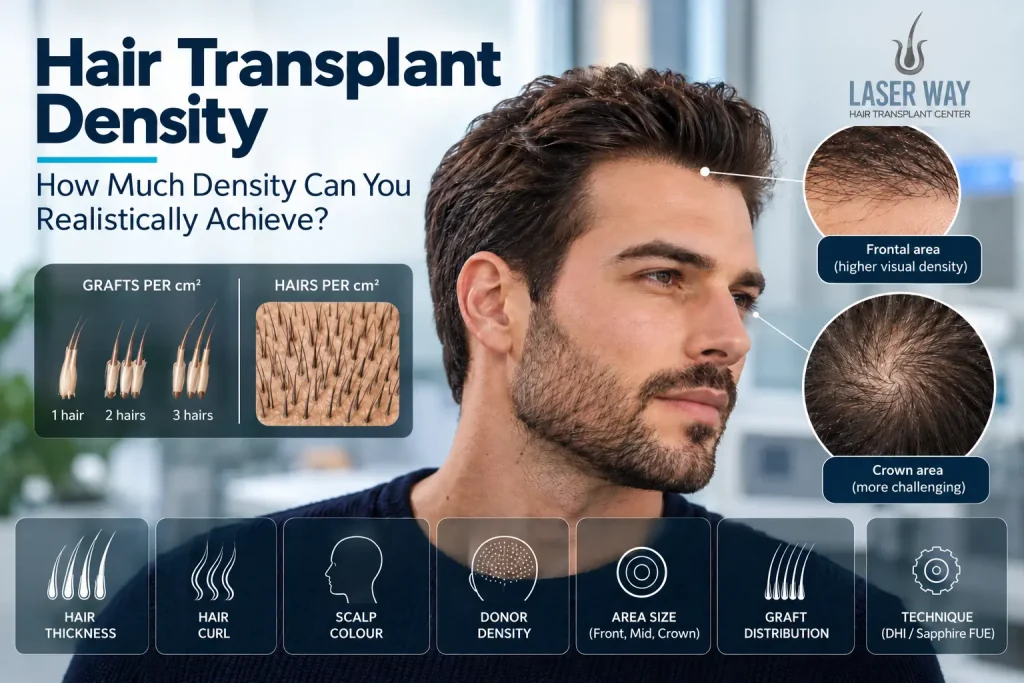
What Does Hair Transplant Density Mean?
Hair transplant density refers to how closely transplanted follicular units are placed within a particular area of the scalp.
It is often discussed in terms of grafts per square centimetre, but this number does not tell the whole story.
A graft can contain:
- one hair;
- two hairs;
- three hairs;
- sometimes more.
Because of this, graft density and hair density are not exactly the same thing.
For example, an area containing many two- and three-hair grafts may visually appear denser than another area containing mostly single-hair grafts, even when the number of grafts per square centimetre is similar.
Grafts per cm² vs Hairs per cm²
This distinction is important when discussing realistic expectations.
Grafts per cm²
This refers to how many follicular units are implanted within one square centimetre of scalp.
Hairs per cm²
This refers to the total number of individual hairs growing in that same area.
Because one graft can contain more than one hair, the number of hairs per square centimetre can be considerably higher than the number of grafts.
This is why simply asking, “How many grafts per cm² will I receive?” does not always predict how full the result will look.
The quality and composition of those grafts also matter.
Does a Hair Transplant Restore Natural Hair Density?
Usually, a hair transplant does not reproduce the exact density someone had before hair loss began.
That should not automatically be considered a poor result.
The purpose of a transplant is normally to create natural-looking visual coverage using the available donor follicles.
Native scalp hair can be very dense, particularly in younger people who have not experienced significant thinning.
Trying to reproduce that same density across a large bald area may require more grafts than the donor area can safely provide.
A well-planned transplant therefore aims to create the appearance of density rather than simply chasing the highest possible graft number.
Why Can a Hair Transplant Look Dense Even With Lower Density?
The human eye does not measure grafts.
It sees contrast, coverage, direction and the amount of scalp visible between hairs.
Several characteristics can make transplanted hair appear fuller.
Hair thickness
Thicker individual hairs provide more visual coverage than very fine hairs.
A patient with coarse hair may therefore appear denser than someone with finer hair even if both receive a similar number of grafts.
Hair curl or wave
Curly or wavy hair tends to cover more scalp surface than very straight hair.
This can create the appearance of greater density.
Hair and scalp colour
When hair colour and scalp colour are similar, there is usually less visible contrast.
When very dark hair grows against a light scalp, any gaps between hairs can be easier to notice.
Hair direction
Correct angulation and direction allow hairs to overlap naturally.
This can improve visual coverage without increasing the number of grafts.
Hair length and styling
Longer hair can provide more coverage than very short hair because individual hairs overlap neighbouring areas.
This is another reason why density cannot be judged purely by a numerical graft count.

Why More Grafts Do Not Always Mean Better Density
It is tempting to assume that the best transplant is the one with the highest number of grafts.
That is not necessarily true.
The donor area contains a limited number of follicles that can be safely extracted.
Using too many grafts in one session or concentrating too heavily on one area can create problems for long-term planning.
A patient’s future hair loss also needs to be considered.
If a large proportion of the available donor follicles is used early, fewer grafts may remain available if thinning progresses elsewhere later.
Good hair restoration therefore requires balance.
The objective is not simply:
“How many grafts can we implant?”
A better question is:
“How can we use the available grafts to create the most natural and sustainable result?”
How Donor Density Affects the Final Result
The donor area is one of the most important factors affecting transplant density.
The donor area normally includes the back and sides of the scalp, where follicles are generally more resistant to pattern hair loss.
Patients differ significantly in:
- follicular density;
- hair thickness;
- percentage of multi-hair grafts;
- donor-area size;
- hair texture;
- safe extraction capacity.
Someone with a strong donor area may have more options for achieving higher coverage than someone with naturally lower donor density.
This is why the donor area should always be evaluated before deciding how much density can realistically be achieved.
You can learn more in our guide to the hair transplant donor area.
Why Two Patients With the Same Number of Grafts Can Look Different
Imagine two patients who each receive 3,000 grafts.
Patient A has:
- thick hair;
- slight natural curl;
- good donor density;
- lower contrast between hair and scalp;
- a relatively compact recipient area.
Patient B has:
- very fine straight hair;
- strong colour contrast with the scalp;
- a larger bald area;
- lower donor density.
Even with the same number of grafts, Patient A may appear significantly denser.
This is why graft count alone cannot predict the final visual result.
Hairline Density vs Crown Density
The frontal hairline and crown are usually treated differently.
Hairline density
The frontal area is highly visible and has a strong effect on the overall appearance of the face.
Single-hair grafts are commonly used near the front to create a soft, natural transition.
Behind the hairline, larger follicular units can help increase the appearance of density.
Crown density
The crown is more difficult because the hair usually grows in a spiral or whorl pattern.
The crown can also represent a large surface area.
A significant number of grafts may therefore be required to create convincing coverage.
This is one reason why patients with extensive hair loss may not receive the same density in the crown as in the frontal region.
Donor follicles need to be distributed strategically.
What Determines How Many Grafts Are Needed for Density?
The number of grafts required depends on several factors:
- total size of the thinning or bald area;
- amount of existing native hair;
- donor density;
- hair calibre;
- hair texture;
- level of scalp contrast;
- desired visual coverage;
- whether the front, mid-scalp and crown all need treatment.
The same number of grafts can produce very different outcomes depending on how large an area they need to cover.
For a detailed explanation, read our guide on how many grafts are needed for a hair transplant.
Can Hair Transplant Density Be Too High?
Higher density is not automatically better.
Grafts need sufficient space and blood supply during the healing process.
The recipient area also has biological limits.
Trying to place an excessive number of grafts into a very small area is not always appropriate.
The ideal density depends on the condition of the scalp, the recipient area and the patient’s individual characteristics.
This is why transplant planning should be based on medical assessment rather than a predetermined maximum density.
How Existing Hair Changes the Density Plan
Not every patient is completely bald in the recipient area.
Many people still have thinning native hair.
In these cases, the medical team needs to consider both the transplanted follicles and the existing hair.
Transplanting between native hairs requires careful placement.
The patient’s future hair-loss pattern also matters because native hair can continue to thin even after transplantation.
A treatment plan should therefore consider how the scalp may look not only immediately after the procedure, but several years later.
DHI and Hair Transplant Density
Direct Hair Implantation, or DHI, is one of the techniques used at Laser Way.
With DHI, extracted follicles are implanted using an implanter device.
This allows the medical team to control factors such as:
- placement;
- direction;
- angle;
- spacing between follicles.
These factors are important when trying to create the appearance of natural density.
However, technique alone does not determine the final result.
Donor quality, graft survival, hair characteristics and the size of the recipient area remain equally important.
Learn more about the technique on our DHI hair transplant page.
Sapphire FUE and Density
Sapphire FUE is another hair transplant technique used at Laser Way.
During Sapphire FUE, channels are created in the recipient area before the grafts are implanted.
The planning of these channels helps determine:
- where follicles are placed;
- how closely they are positioned;
- the direction of future growth;
- the overall distribution of grafts.
As with DHI, the technique should be selected according to the patient’s individual needs rather than based only on a desire for maximum density.
Does Graft Survival Affect Density?
Yes.
A transplant may be planned with a certain number of grafts, but the final result depends on successful healing and growth.
Factors that can influence the outcome include:
- careful extraction;
- handling of follicles;
- implantation technique;
- recipient-area condition;
- post-procedure care;
- individual healing response.
For this reason, the number of grafts implanted on the day of surgery is only one part of the final density result.
When Does Hair Transplant Density Become Visible?
Hair transplant density develops gradually.
Immediately after the procedure, the transplanted grafts are visible, but this is not the final result.
During the following weeks, many transplanted hairs can shed.
This is part of the normal growth cycle.
New growth begins gradually in the following months.
As the hair becomes longer and thicker, the appearance of density improves.
Final maturation takes time, so patients should not judge the density of their transplant too early.
Can a Second Hair Transplant Increase Density?
In some cases, yes.
A second procedure may be considered when:
- the donor area remains strong;
- the first transplant has fully matured;
- the patient wants additional density;
- hair loss has progressed;
- another part of the scalp now requires treatment.
However, the decision should depend on remaining donor capacity.
Using donor follicles conservatively is important because the donor area is not unlimited.
The goal should always be long-term hair restoration rather than maximizing density in one isolated procedure.
What Is Realistic Hair Transplant Density?
There is no single density target that is ideal for every patient.
A realistic result depends on the relationship between:
- donor supply;
- recipient-area size;
- hair characteristics;
- extent of hair loss;
- expected future hair loss;
- desired appearance.
For one patient, excellent visual coverage may be possible with moderate graft density.
For another, the same level of coverage may require considerably more grafts.
This is why personalized planning is essential.
How Laser Way Plans Hair Transplant Density
Laser Way has specialized in hair transplantation since 2004.
Before treatment, the medical team evaluates both the donor and recipient areas to determine how the available follicles should be distributed.
The assessment includes:
- donor-area density;
- hair thickness;
- hair-loss pattern;
- size of the recipient area;
- existing native hair;
- natural direction of hair growth;
- long-term hair-loss progression.
The objective is not simply to maximize graft numbers.
The aim is to create balanced, natural-looking coverage while preserving the donor area for the future.
Frequently Asked Questions
What is a good hair transplant density?
There is no universal number that is ideal for every patient. Appropriate density depends on donor quality, hair thickness, recipient-area size and the amount of existing hair.
How many grafts per cm² are needed?
The number varies according to the area being treated and individual hair characteristics. Grafts per square centimetre should not be considered in isolation because each graft can contain a different number of hairs.
Can a hair transplant achieve 100% natural density?
A transplant generally does not recreate the exact density someone had before hair loss. The goal is usually to create natural-looking visual coverage using the available donor follicles.
Why does my transplant look less dense when my hair is short?
Short hair exposes more of the scalp and reduces the overlap between individual hairs. As transplanted hair grows longer, coverage can appear fuller.
Does thick hair give better transplant density?
Thicker hair often provides greater visual coverage than fine hair because each strand covers more scalp surface.
Is crown density harder to achieve?
It can be. The crown often covers a large area and grows in a spiral pattern, which can require a significant number of grafts to create convincing visual coverage.
Can DHI create higher density?
DHI allows careful control of graft placement, angle and direction, but the achievable density still depends on donor supply, recipient-area condition and individual hair characteristics.
Can I add more density later?
Possibly. A second procedure can sometimes be considered after the first transplant has fully matured, provided the donor area still has sufficient safe extraction capacity.
Conclusion
Hair transplant density is not simply a question of how many grafts are implanted.
The final appearance depends on the donor area, hair thickness, graft composition, recipient-area size, hair direction, scalp contrast and long-term hair-loss pattern.
Two patients receiving exactly the same number of grafts can therefore achieve very different visual results.
A successful transplant should use the available donor follicles strategically to create natural-looking coverage while preserving options for the future.
If you are considering a hair transplant and want to understand what level of density may be realistic for your case, contact Laser Way Clinic in Tirana for an individual evaluation.