


One of the most common questions patients ask before a hair transplant is: “How many grafts do I need?”
There is no single number that applies to everyone. The number of grafts required depends on the size of the area affected by hair loss, the desired density, the condition of the donor area, individual hair characteristics, and the pattern and progression of hair loss.
Two patients with a similar degree of hair loss may require a different number of grafts. For this reason, the final graft estimate should be based on an individual assessment.
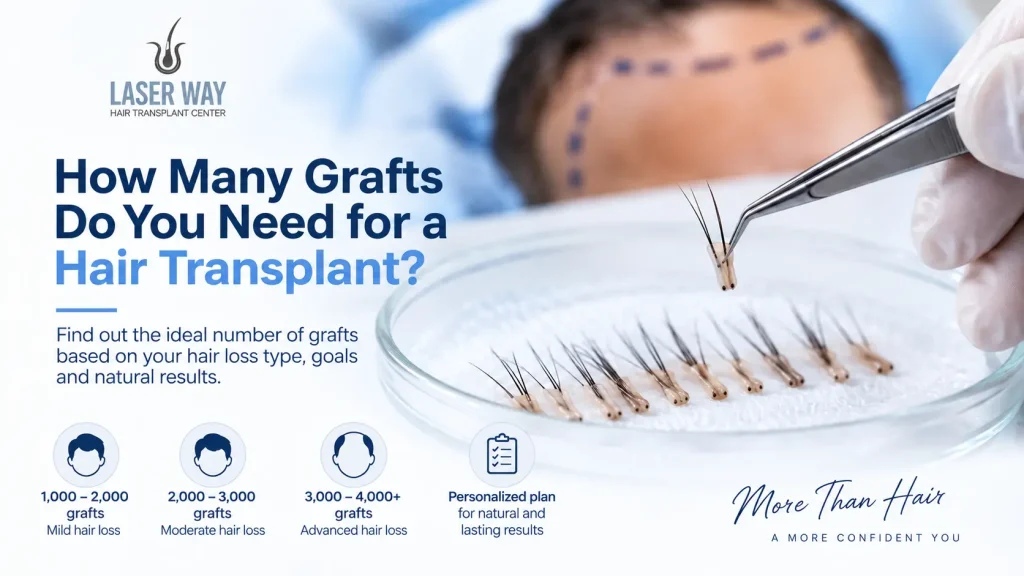
What Is a Hair Graft?
A graft is a follicular unit that is extracted from the donor area and transplanted into an area where hair has thinned or been lost.
A graft does not necessarily contain just one hair. A follicular unit may contain one or several hairs.
This means that 2,000 grafts do not necessarily equal 2,000 hairs. The actual number of transplanted hairs can be higher depending on the composition of the follicular units.
How Many Grafts May Be Needed for a Hair Transplant?
There is no standard graft number for every patient. However, the following ranges can provide a general idea of the scale of a procedure:
| Number of grafts | May generally be associated with |
|---|---|
| 1,000–1,500 | Relatively small areas or limited corrections |
| 1,500–2,500 | Hairline and/or frontal thinning |
| 2,500–3,500 | More extensive frontal and mid-scalp hair loss |
| 3,500–4,000+ | Larger areas with significant hair loss |
These ranges are only general estimates. They should not be used to determine how many grafts an individual patient needs.
Even two areas of similar size may require very different treatment plans.
What Determines How Many Grafts You Need?
Several factors should be considered when estimating the number of grafts for a hair transplant.
1. Size of the Area Being Treated
The larger the area affected by hair loss, the more grafts may be required.
A small correction to the hairline does not have the same graft requirements as a procedure involving the frontal area, mid-scalp and crown.
2. Condition of the Donor Area
The donor area is one of the most important factors in hair transplant planning.
It is not enough to determine how many grafts we want to transplant. We also need to determine how many grafts can appropriately be extracted from the donor area.
Its density, quality and distribution directly influence the treatment plan.
We explain this in more detail in our guide to the donor area and how many grafts can be safely extracted.
3. Desired Density
The goal of a hair transplant is not simply to place as many grafts as possible into a given area.
Grafts need to be distributed according to the existing density, characteristics of the patient’s hair and the area being treated.
Some patients still have existing hair within the treatment area, while others may have extensive areas with little or no remaining hair. This changes how the grafts need to be planned.
4. Hair Thickness and Characteristics
Not all hair creates the same visual impression of density.
Hair shaft thickness, texture, color, contrast with the scalp and other characteristics can affect how dense the transplanted area appears.
As a result, two patients receiving the same number of grafts may not achieve the same visual coverage.
5. Hairline Design
When the frontal area is treated, some of the available grafts are used to create or restore the hairline.
Hairline design should take into account facial proportions, age and the possible future progression of hair loss.
An excessively low hairline may require more grafts and consume a greater portion of the available donor supply.
How Many Grafts Are Needed for the Frontal Area?
The frontal area is one of the most commonly treated areas in hair transplantation.
The number of grafts required depends on how far the hairline has receded, the width of the area, existing density and the intended coverage.
Some patients may require treatment only around the temples or corners of the hairline, while others may require reconstruction of a much larger frontal area.
For this reason, there is no single graft number that can be recommended for every frontal hair transplant.
How Many Grafts Are Needed for the Crown?
The crown requires a different approach to planning.
Hair in this area naturally grows in a characteristic pattern, and the affected area may become larger as hair loss progresses.
For patients with hair loss affecting both the frontal area and crown, the available donor grafts need to be distributed carefully.
In some cases, priority may be given to the frontal area before considering additional coverage of the crown.
Are 3,000 Grafts Enough for a Hair Transplant?
They may be enough for one patient but not for another.
Instead of asking only:
“Are 3,000 grafts enough?”
a more useful question is:
“What area needs to be covered with those 3,000 grafts, and what does the donor area allow?”
Using 3,000 grafts over a relatively limited area can produce very different coverage from distributing the same number across a much larger area.
Is More Always Better?
No.
More grafts do not automatically mean a better hair transplant.
Extraction needs to respect the capacity of the donor area. Excessive harvesting may negatively affect its appearance and may also reduce the options available for future procedures.
The recipient area must also be planned according to the patient’s individual characteristics.
The objective is therefore to use the available grafts efficiently rather than simply trying to achieve the highest possible graft count.
Why Should Future Hair Loss Be Considered?
A hair transplant should not be planned only around how a patient’s hair looks today.
Existing non-transplanted hair may continue to thin after the procedure. This can be particularly important in younger patients or when the pattern of hair loss has not stabilized.
For this reason, planning should also consider possible future hair loss and the preservation of donor grafts that may be needed later.
How Does Laser Way Clinic Determine the Number of Grafts?
At Laser Way Clinic, the number of grafts is determined individually after assessing the patient’s hair and donor area.
The planning process considers factors including:
- the extent and pattern of hair loss;
- the size of the area to be treated;
- donor-area density and quality;
- individual hair characteristics;
- hairline design and intended coverage;
- the possible progression of future hair loss.
Laser Way Clinic has specialized in hair transplantation since 2004 and has performed more than 15,000 hair transplants. Modern techniques including DHI and Sapphire FUE are used according to the individual characteristics and treatment plan of each patient.
There Is No Ideal Graft Number for Everyone
1,500, 2,500 or 4,000 grafts do not, by themselves, indicate whether a hair transplant will be better or worse.
The appropriate number is the number that fits the area requiring treatment, the capacity of the donor area and the patient’s long-term hair restoration plan.
An individual assessment is therefore important before determining the number of grafts for a hair transplant.
Frequently Asked Questions
How many hairs are in one graft?
A graft may contain one or several hairs. Therefore, the number of grafts and the total number of transplanted hairs are not the same.
Are 2,000 grafts enough for a hair transplant?
It depends on the area being treated, existing density, hair characteristics and donor-area capacity. For some patients 2,000 grafts may be sufficient, while for others they may not be.
Are 4,000 grafts too many?
Not necessarily. However, a graft number of this size should only be considered after evaluating the donor area and the size of the recipient area. A higher graft count does not automatically mean a better result.
Can all the grafts be extracted in one session?
This depends on the number of grafts required, the donor area, the technique used and the patient’s individual assessment. Not every patient is suitable for the same graft count in a single procedure.
Could I need another hair transplant in the future?
Yes, in some cases. Transplanted hair and the progression of hair loss in existing non-transplanted hair are separate considerations. This is one reason why long-term donor-area planning is important.