


Yes, a second hair transplant is possible for many patients, but not everyone needs or qualifies for another procedure. Whether a second transplant is appropriate depends on the results of the first surgery, the remaining donor hair supply, the progression of hair loss, and the patient’s expectations.
Some people consider another hair transplant because they want greater density. Others experience additional hair loss in areas that were not treated during their first procedure. A second transplant may also be considered to improve an unnatural hairline or address an unsatisfactory previous result.
At Laser Way Clinic, we understand that every hair restoration journey is different. In this guide, we explain when a second hair transplant may be necessary, how long patients should wait, and what determines whether another procedure is possible.
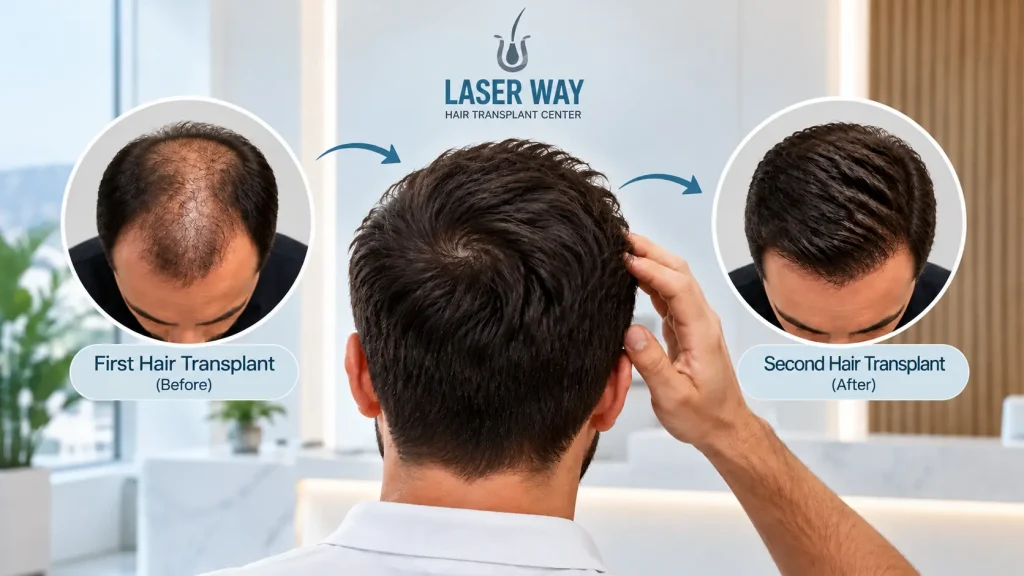
Why Would Someone Need a Second Hair Transplant?
Having a second hair transplant does not necessarily mean the first procedure failed. Hair loss can continue over time, even when the transplanted follicles are growing successfully.
There are several reasons why patients may consider another procedure.
1. Continued Loss of Natural Hair
Hair follicles used for transplantation are generally selected from areas that are more resistant to hereditary hair loss.
However, the patient’s original, non-transplanted hair may continue to thin.
This can create new gaps around previously transplanted hair, particularly along the frontal area, mid-scalp, or crown.
A second hair transplant may help restore coverage in these newly affected areas.
It is important to understand that hair transplantation does not stop the underlying progression of androgenetic alopecia.
Learn more in our article about whether a hair transplant is permanent.
2. Insufficient Density After the First Procedure
Some patients achieve a natural-looking hairline but would prefer additional density.
The final appearance depends on several factors, including the number of grafts implanted, the characteristics of the patient’s hair, the size of the treated area, and graft survival.
A second procedure may be considered to improve density in selected areas.
However, patients should first allow sufficient time for the initial transplant to mature before deciding whether additional surgery is necessary.
3. Correcting a Previous Hair Transplant
Another reason for a second procedure is to improve the appearance of an earlier transplant.
Common concerns include:
- An unnatural or overly straight hairline.
- Incorrect hair growth direction.
- Uneven graft distribution.
- Visible gaps between transplanted areas.
- Insufficient coverage or density.
Corrective procedures can be more complex than an initial transplant, particularly when the donor area has already been heavily used.
Adding more grafts is not always the appropriate solution. Each case requires a careful assessment.
How Long Should You Wait Before a Second Hair Transplant?
In many cases, patients are advised to wait approximately 12 months after their first hair transplant before evaluating the final result and considering another procedure.
Hair transplantation is a gradual process.
During the early months, transplanted hair shafts may shed temporarily before new growth begins. Hair density and thickness then improve progressively.
Some areas, especially the crown, may take longer to reach their final appearance.
This means that a transplant that looks relatively thin at six months may still improve considerably.
The appropriate waiting period should be determined through an individual medical assessment.
Is There Enough Donor Hair for a Second Transplant?
One of the most important factors in planning a second hair transplant is the condition of the donor area.
The donor area, usually located at the back and sides of the scalp, provides the follicles used for transplantation.
When follicles are extracted, they do not regenerate at the extraction sites. Therefore, the available donor supply is limited.
Before recommending another procedure, the medical team should evaluate:
- Remaining donor hair density.
- Hair thickness and quality.
- The number of grafts extracted previously.
- The distribution of earlier extractions.
- Any visible thinning or scarring.
- The size of the area requiring additional coverage.
Excessive harvesting can make the donor area appear thin or uneven.
For this reason, donor management is particularly important when planning more than one procedure.
Read our detailed guide to the hair transplant donor area.
How Many Grafts Are Needed for a Second Hair Transplant?
There is no standard number of grafts required for a second hair transplant.
Someone seeking a small density improvement along the hairline may need a very different treatment plan from someone experiencing extensive new hair loss across the crown.
The number of grafts depends on the area being treated, the desired coverage, existing hair density, and the remaining donor supply.
A second transplant must also account for the placement of previously implanted follicles.
You can learn more about graft planning in our guide to how many grafts are needed for a hair transplant.
Is a Second Hair Transplant More Difficult Than the First?
A second hair transplant can be more technically demanding, although this is not always the case.
Previous surgery may have affected the donor area’s density or the characteristics of the recipient scalp.
When new grafts are placed between existing hairs, careful planning is required to reduce the risk of damaging follicles already present.
The surgeon must also consider hair direction, implantation angles, distribution, and the overall design of the hairline.
For corrective procedures, additional factors such as scarring or unnatural graft placement may need to be addressed.
DHI or Sapphire FUE: Which Is Better for a Second Hair Transplant?
Both DHI and Sapphire FUE can be considered for hair restoration procedures, depending on the patient’s individual circumstances.
With DHI hair transplantation, grafts are implanted using a specialized implantation instrument.
With Sapphire FUE, sapphire-tipped instruments are used to create recipient channels before graft placement.
Neither technique guarantees a better result for every second hair transplant.
The most appropriate approach depends on the condition of the scalp, existing hair, donor supply, and treatment objectives.
A personalized assessment is essential before selecting a technique.
Can You Have a Second Hair Transplant If the First One Failed?
In some cases, yes.
However, the reason for the unsatisfactory first result should be investigated before planning another procedure.
Possible contributing factors include poor graft survival, unsuitable treatment planning, ongoing natural hair loss, or medical conditions affecting scalp health and hair growth.
If the underlying issue has not been addressed, another transplant may not provide the desired improvement.
The remaining donor supply must also be evaluated carefully.
When donor resources are insufficient, further transplantation may not be recommended.
What Results Can You Expect From a Second Hair Transplant?
The objective of a second hair transplant may be to improve density, restore coverage in newly affected areas, or correct aspects of an earlier procedure.
However, results vary depending on:
- Donor hair availability.
- Graft quality and characteristics.
- Existing hair density.
- Scalp condition.
- Future progression of hair loss.
- Treatment planning and surgical execution.
A second transplant cannot guarantee restoration of the patient’s original hair density.
Realistic expectations are essential, especially when the donor supply is limited.
Second Hair Transplant Consultation at Laser Way Clinic
Laser Way Clinic has specialized in hair transplantation since 2004.
When assessing a patient who has undergone a previous hair transplant, the medical team considers the existing result, the donor area, the pattern of hair loss, and the patient’s goals.
Patients are encouraged to provide information about their first procedure, including when it was performed, which technique was used, and how many grafts were extracted, if these details are available.
This information can help guide the evaluation and determine whether another procedure may be appropriate.
To discuss your situation, contact Laser Way Clinic for a consultation.
Frequently Asked Questions About a Second Hair Transplant
Can you have two hair transplants?
Yes. Some patients can undergo two or more hair transplant procedures during their lifetime. Eligibility depends on the remaining donor supply, scalp health, and the need for additional treatment.
How soon can you have a second hair transplant?
Many patients are advised to wait around 12 months before assessing the final result of their first transplant. Some cases may require a longer waiting period.
Can a second hair transplant increase density?
Yes, a second procedure may improve density in selected areas if sufficient donor grafts are available and the scalp is suitable for further treatment.
Can a second transplant damage existing hair?
There is a risk of damaging existing follicles when placing new grafts between them. Careful planning and appropriate technique aim to minimize this risk but cannot eliminate it completely.
Is a second hair transplant more expensive?
Not necessarily. The cost depends on the number of grafts, the complexity of the procedure, the technique used, and the condition of the donor area.
Can I have another transplant if my donor area is weak?
Not always. If the donor area has insufficient density or was overharvested during the first procedure, further extraction may not be advisable.
Conclusion: Is a Second Hair Transplant Worth Considering?
A second hair transplant may be an option for patients seeking additional density, coverage of newly thinning areas, or correction of an earlier result.
However, another procedure should not be planned solely because a patient wants more hair.
The condition of the donor area, the time elapsed since the first transplant, and the progression of natural hair loss are essential considerations.
A professional consultation can help determine whether a second hair transplant is possible, what limitations exist, and what results may realistically be expected.
If you have already undergone hair transplantation and are considering another procedure, contact Laser Way Clinic to discuss your options.