


The donor area is one of the most important factors in planning a hair transplant. Even when a patient has a large area of hair loss they would like to restore, the number of grafts that can be transplanted depends significantly on the quality and capacity of the donor area.
For this reason, hair transplant planning should not focus only on the question:
“How many grafts do I need?”
An equally important question is:
“How many grafts can be extracted while preserving the natural appearance of the donor area?”
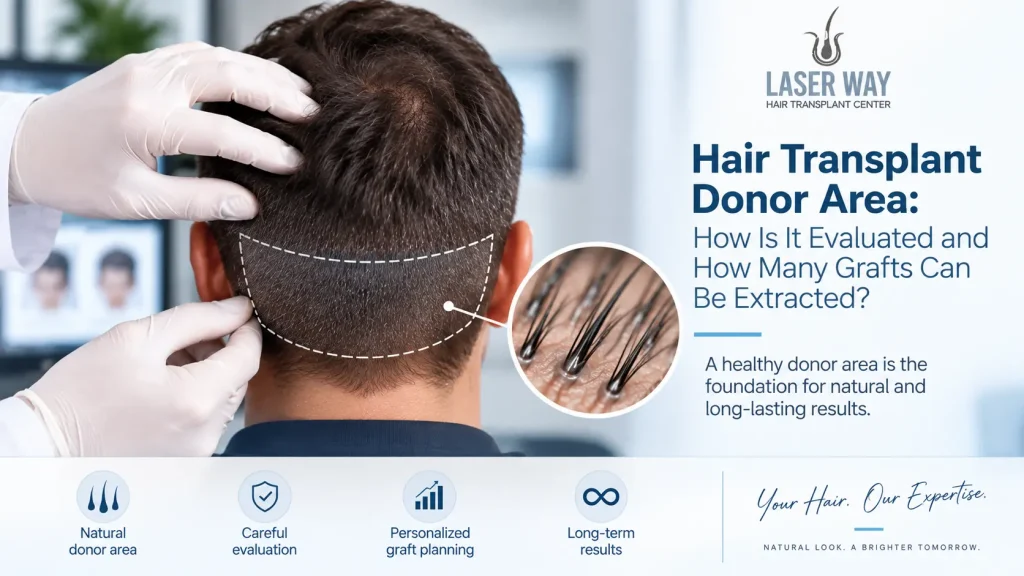
What Is the Donor Area in a Hair Transplant?
The donor area is the part of the scalp from which follicular units are extracted before being transplanted into areas affected by hair loss.
In hair transplantation, the donor area generally includes suitable regions at the back and sides of the scalp.
With modern hair transplant techniques such as DHI and Sapphire FUE, follicular units are extracted individually and then used according to the planned distribution in the recipient area.
Why Is the Donor Area So Important?
The supply of grafts available for transplantation is not unlimited.
A patient with extensive hair loss cannot automatically receive a very high number of grafts simply because a large area needs coverage.
The donor area first needs to be evaluated to determine how many grafts can appropriately be extracted without unnecessarily compromising its density and appearance.
For this reason, donor-area management is an important part of long-term hair transplant planning.
How Is the Donor Area Evaluated Before a Hair Transplant?
Assessing a donor area involves more than simply looking at whether a patient appears to have plenty of hair at the back of the head.
Several factors need to be considered.
Donor Hair Density
One important factor is the number and distribution of follicular units within the donor area.
An area with greater density may provide more options for graft extraction and distribution than a naturally lower-density donor area.
However, density alone does not determine the entire treatment plan.
Hair Quality and Characteristics
Hair shaft thickness, texture and other characteristics can influence the visual effect of density and coverage.
Therefore, two patients with similarly sized donor areas do not necessarily have the same donor capacity or the same options for transplantation.
Distribution of Graft Extraction
It is important to consider not only how many grafts are extracted, but also where they are extracted from.
Extraction should be distributed carefully rather than concentrated excessively within a small area.
The objective is to obtain the grafts required for transplantation while preserving as natural and balanced an appearance as possible in the donor region.
Pattern and Progression of Hair Loss
Planning should also consider how the patient’s hair loss may progress in the future.
This is particularly important for younger patients and for patients with progressive hair loss.
Using a large proportion of the available donor supply during an initial procedure may reduce the options available if additional areas require treatment later.
How Many Grafts Can Be Extracted From the Donor Area?
There is no universal number of grafts that can appropriately be extracted from every patient’s donor area.
Donor capacity varies according to factors including:
- donor density;
- size of the suitable donor area;
- hair characteristics;
- previous hair transplant procedures;
- the pattern and extent of hair loss;
- possible future hair loss.
For this reason, statements such as “every patient can have 4,000 grafts extracted” should not be treated as a general rule.
A graft count that may be appropriate for one patient could be excessive for another.
For a more detailed explanation of how the required graft number is determined, read our guide to how many grafts are needed for a hair transplant.
What Is Donor Area Overharvesting?
Overharvesting occurs when excessive extraction, or poorly distributed extraction, results in unnecessary thinning or an uneven appearance in the donor area.
This is one reason why the objective of a hair transplant should not simply be to extract the maximum possible number of grafts.
Instead, the number and distribution of extracted grafts should be planned according to the characteristics and capacity of the individual donor area.
Preserving the donor area can also be important if another hair transplant is needed in the future.
Does Graft Extraction Leave Visible Gaps in the Donor Area?
With modern individual follicular-unit extraction techniques, grafts are taken from multiple points across the suitable donor area rather than by removing a strip of scalp.
When extraction is appropriately planned and distributed, the objective is for the remaining surrounding hair to maintain natural-looking coverage.
However, the appearance of the donor area after a procedure depends on factors such as:
- its original density;
- the number of grafts extracted;
- hair characteristics;
- the distribution of extraction points;
- individual healing.
This is why the same graft number cannot be considered equally appropriate for every patient.
Do Grafts Grow Back in the Donor Area After Extraction?
This is an important distinction.
When an intact follicular unit is extracted from the donor area and transplanted elsewhere, that follicular unit is no longer present at its original location to produce the same hair there.
The surrounding follicles that were not extracted remain in the donor area and continue their normal hair-growth cycles.
This is another reason why donor grafts should be regarded as a limited resource that needs careful planning.
What Happens to the Donor Area After a Hair Transplant?
After the procedure, the donor area goes through a healing period.
During the first days, temporary redness and small extraction points may be visible. The appearance of the area gradually changes as healing progresses and the surrounding hair continues to grow.
Recovery varies between patients and can depend on the extent of the procedure and individual healing characteristics.
Patients should follow the post-procedure instructions provided by their clinic during this period.
Why Shouldn’t All Available Grafts Be Used Immediately?
Hair loss can continue after a hair transplant.
For example, a patient who currently requires frontal restoration may later experience additional thinning in the mid-scalp or crown.
If the donor area is used too aggressively during the first procedure, fewer options may remain for treating future hair loss.
Long-term planning therefore considers not only the patient’s current appearance but also how the available donor supply may need to be used in the future.
What If the Donor Area Is Not Strong Enough?
Not every patient has sufficient donor capacity to provide the desired coverage across every area affected by hair loss.
When donor supply is limited, priorities may need to be established.
For example, greater emphasis may be placed on areas that contribute most strongly to the overall visual appearance while preserving part of the donor supply for potential future needs.
The appropriate approach depends on the individual assessment.
How Does Laser Way Clinic Evaluate the Donor Area?
At Laser Way Clinic, hair transplant planning includes an assessment of both the donor area and the areas requiring restoration.
Factors such as donor density, hair characteristics, the pattern of hair loss, the number of grafts required and their planned distribution are considered when developing the treatment plan.
Laser Way Clinic has specialized in hair transplantation since 2004 and has performed more than 15,000 hair transplants, using modern techniques including DHI and Sapphire FUE.
The objective is to create an individual plan that uses the available donor grafts carefully while also considering the possible future progression of hair loss.
Donor Area Planning Is About More Than the Maximum Graft Count
The donor area is one of the most important resources available in a hair transplant and should be managed carefully.
The question should not simply be:
“How many grafts can we extract?”
It should also be:
“How many grafts is it appropriate to extract while preserving the donor area and planning for the future?”
Balancing the donor area, recipient area and possible progression of hair loss is therefore an important part of creating an individualized hair transplant plan.
Frequently Asked Questions
Does donor hair grow back after extraction?
The surrounding hair continues to grow, but an intact follicular unit that has been completely extracted and transplanted is no longer present in its original location. This is why graft extraction needs to be planned carefully.
Can the donor area be damaged?
Excessive or poorly distributed extraction can negatively affect the density and appearance of the donor area. Appropriate assessment and extraction planning are therefore important.
How long does the donor area take to heal?
Healing begins immediately after the procedure, but the time required for the donor area to recover and its appearance to normalize varies between patients and procedures.
Can the donor area be used for a second hair transplant?
In some cases, yes. This depends on the remaining donor capacity, previous procedures, hair-loss pattern and individual assessment.
Does everyone have the same donor capacity?
No. Donor density, the size of the suitable donor area, hair characteristics and hair-loss history vary between individuals.